Tuesday, February 14, 2012
A Few Trillion Dollars is Missing. Please Call If You Find It.
The White House released its proposed Fiscal 2013 budget yesterday. In the Budget Message of the President, Obama states, "Together with the deficit reduction I signed into law this past year, this Budget will cut the deficit by $4 trillion over the next decade." The deficit reduction he signed into law this past year refers to a $1 trillion cut from the Budget Control Act of 2011, so according to Obama this budget results in an additional $3 trillion in cuts. That is impressive. But I just can't find it.
The tables below show the cumulative five and ten (when available) projected federal government receipts, outlays and deficits for the F08 through F13 proposed budgets. The F08 budget 5 year projection is the cumulative projected receipts, outlays and deficits for fiscal years 2008 through 2012, F09 from fiscal years 2009 through 2013 and so on.
President Obama says he was left a "projected 10-year deficit of more than $8 trillion." (The only way to get to $8 trillion is to take the F10 budget and time shift the projection one-year backward, only one of the many dishonest aspects of the President's message, but I digress). This suggests the F10 budget wasn't his, a common assertion made by the Obama apologists. It's an odd claim to make, since he submitted the budget to Congress and he signed the bill. I do agree his options were limited for the F10 budget, but for God's sake, Man Up Mr. President.
But I digress. Where the heck is the $4 trillion dollars of deficit reduction? It's gone missing! The fiscal 2010 budget, (which although submitted by Obama and signed by Obama is not Obama's) had a ten-year projected cumulative deficit of close to $7 trillion. The fiscal 2011 budget, which presumably was Obama's, was even worse, with a ten-year projected cumulative deficit of $8.5 trillion. So at best, Obama has lowered the deficit to $6.7 trillion, a $1.3 trillion reduction from his fiscal 2011 proposal, and only $300 billion from the budget he "inherited."
The spending tables also belie the tale about fiscal responsibility coming from the White House. Remember, the Fiscal 2010 budget, the budget Obama inherited, was called "A New Era of Responsibility: Renewing America's Promise." Five-year projected cumulative spending in fiscal 2010 was $18.8 trillion and the ten year at $42.2 trillion. After painful and hard choices were made, the fiscal 2013 budget calls for 5 year cumulative spending of $20.6 trillion and ten-year spending at $47 trillion.
All politicians play games with language about cuts and hard choices. But the scale and scope of this President is unprecedented.
Bill
Monday, February 13, 2012
A Trip Down Memory Lane Redux.
Eli,
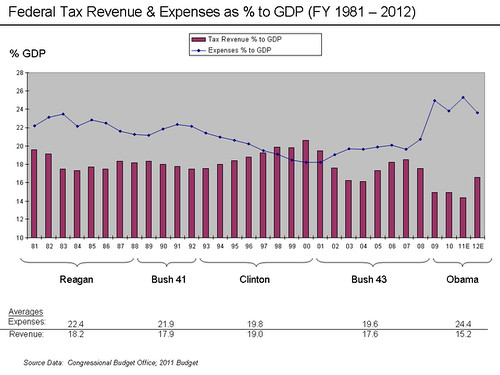
Love that chart on the annual revenues and outlays since Reagan. Let's look at the summary table CBO has at the bottom of the chart. With that data we can calculate the simple average (weighted average would be better) deficit for each President:
President Avg. Deficit/GDP
Clinton -0.8%
Bush 43 -2.0%
Bush 41 -4.0%
Reagan -4.2%
Obama -9.2%
Now I know you imply I characterize Bush 43 as a paragon of fiscl rectitude, which I don't, and I know you are being a bit snide (admit it), but from the numbers you show, well, he was.
Here's the other thing. So the Obama deficits are the fault of Bush. But the Bush policies, which presumably were in place for the Bush administration resulted in 2% deficits, but when Obama becomes President they are magically turned into 9.2% deficits. GDP is about $15 trillion per year. The gap between the Presidents is about 7% of $15 trillion, or $1 trillion. The notion that Bush is responsible for Obama's deficits just doesn't add. Or as they say in Texas, "That dog don't hunt."
A Trip Down Memory Lane
Health Care Is Not A New Car Or A New Coat.
Sunday, February 12, 2012
In the Tradition of Milton Friedman
I was reading an article on the economic interpretation of the Constitution versus the Articles of Confederation and ran across this quote, "Milton Friedman said that countries confront problems only after they have become a crisis." It made me think of your "How It Will End."
Congratulations. Your thinking is in line with the tradition of Milton Friedman.
Bill.
Saturday, February 11, 2012
Fee for Service versus Managed Care.
You have kept me busy recently, and I haven't adequately responded to your "Ain't Nothin' In Life Free," from a few days ago.
According to you the worst part of the healthcare market is you "get paid for doing stuff," but even worse is "getting paid for what you don't do." That is fee for service is bad, but managed care is worse.
I have no opinion on either system. Why should I? Some people lease their car, some take out a loan, some pay cash, some buy used, some choose to not buy a car at all. What do I care? All I care about is there is little interference between the consumer and the producer. If some would like managed care, God speed. If some would prefer fee for service, fine with me. If someone want to come up with a hybrid, or a completely new way, that should be encouraged.
Why do we think there is ONE way to organize the health care and health insurance markets. What other market can you point to that benefits from this approach. Plus, when we allow the state to be the arbiter of how something can be organized it is very difficult to change because of the entrenched interests. For example, food price supports that outlived their usefulness decades ago, if they were ever useful. We still pay billions for ethanol despite near unanimity they are bad for food prices, bad for the environment and bad for consumers. But its good for Ames, Iowa. And we still can't kill ethanol. We are still paying for a WWII policy, that is a 70-year old temporary decision to allow deductibility of health care premiums to avoid wage and price controls.
The rigidity that will be introduced into the health care/insurance market by ObamaCare is one its worst features.
Bill
Greg Mankiw's Blog:Semantics at the Highest Level
Consider these two policies:
A. An employer is required to provide its employees health insurance that covers birth control.
B. An employer is required to provide its employees health insurance. The health insurance company is required to cover birth control.
I can understand someone endorsing both A and B, and I can understand someone rejecting both A and B. But I cannot understand someone rejecting A and embracing B, because they are effectively the same policy. Ultimately, all insurance costs are passed on to the purchaser, so I cannot see how policy B is different in any way from policy A, other than using slightly different words to describe it.
Yet it seems that the White House yesterday switched from A to B, and that change is being viewed by some as a significant accommodation to those who objected to policy A. The whole thing leaves me scratching my head.