Thursday, May 10, 2012

Stop Your Speculative Madness

Eli,

You asked me, in "Unstable Coalitions And The Question Of Pain," if I knew anywhere you could, "place a bet on Greece leaving the Euro by September?"

Eli, Eli, Eli. I'm disappointed. Why, that's just blatant speculation. SPECULATION Gosh Darn it. Speculation caused the financial crisis. Speculation caused oil prices to go up. Speculation has no useful purpose in our society. Surely you aren't asking me to aid and abet you? I have no intention of helping you drag the Greek economy into the mud.

Take your nefarious plans elsewhere please; this is a family web site.

Bill

Bipartisanship is Overrated

Eli,

More and more I prefer the extremists. The latest reason?

"WASHINGTON (MarketWatch) — In a rare display of election-year bipartisanship, House lawmakers acted Wednesday to renew the charter of the Export-Import Bank of the United States following a deal between a top Republican and Democrat."

According to the Ex-Im Bank's 2011 Annual Report, the Bank made $30 billion of loan guarantees and $12.6 billion of direct loans. Of the $30 billion in guarantees, $11 billion were to countries buying Boeing aircraft. For instance, $375 million was guaranteed to KLM Royal Dutch Airlines so it can compete better against US airlines trying to compete against KLM. The US Government subsidizes loans to foreign governments and companies who then have an advantage in competing against US companies.

The Ex-Im Bank is an wholly-owned financing subsidiary of Boeing and an atrocity of crony capitalism. Only a bipartisan Congress could approve this anathema.

Bring on the extremists.

Bill


Wednesday, May 9, 2012

Descent Into Mediocity

Bill

Meanwhile, I face the prospect of the 1st summer in many years without meaningful baseball

American League  East W L Pct
Baltimore Orioles       19 11  .633 
Tampa Bay Rays       19 11  .633
New York Yankees  16 13  .552 
Toronto Blue Jays     16 14 .533 
Boston Red Sox        12 17 .414

In retrospect the hideous September collapse of the once proud and resilient Boston 9 was not an aberration, but a harbinger of the reality to come. The current group, and more critically, the leadershop that constructed them, violates evey principle necessary for competitive success. They forgot what got them here; integrity, hard work, innovation, demand for value, and most vitally, accepting the the inevitablity of change. Hmmn, that sounds like another former champion now on the hot seat


Eli
  

Unstable Coalitions And The Question Of Pain

Bill,

I ordered Throes of Democracy but haven't started it yet. You are onto something quite important about the disparate strains holding the two dominant parties of the eary18th century together, and the fact that most of those strains exist today. What's remarkable is how the vehicle of the two parties endures even as their constituents rearrange themselves. Once the party of slavery and the white working class, Democrats are now the party of college educated professionals and technocrats, single women and minority Americans. Republicans combine businessmen, fiscal conservatives, religious traditionalists, married women, and high school educated men. Go figure.
But the enduring irony of this rearrangement is that at the top of both parties sit elites that share more similaritiy with each other than with the other members of their political alliances They may be divided  by ideology but not by status. You and I are an archtypal example.

As far as the pain required to restore the nation to fiscal integrity, there's no question of that. The question is how that pain, whenever it inevitably arrives, will be distributed. Many argue that the economy will be harmed by increasing marginal tax rates for top earners. Since I have decided henceforth to remain agnostic on all matters economic, I won't ventrue an opinion about that argument. What I do know is that the quality of my life will not be affected one whit by the decline in my household income that would result if we returned to Clinton era tax rates. Could the millions of Americans affected by the budget cuts in Rep Ryan's proposal say the same?

BTW, know anywhere I can place a bet on Greece leaving the Euro by September?

Eli

Tuesday, May 8, 2012

Hubris

Eli,

How do you fix an economy that's in recession and deeply in debt you ask? I think you are leaving out the part of the question that is troubling our current leaders and the electorate. I'll rephrase it: "How you do fix an economy that's in recession and deeply in debt without causing any pain?" I'm not sure there is a positive answer to that question.

When Obama saved the auto industry he did it by inflicting pain. The companies were put into bankruptcy, jobs were lost, contracts restructured, shareholders were diluted. Although I think the market would have done a better job, at least the job was done.

But we, the collective we, don't want to endure that fix in the mortgage market. Instead we seek ways to avoid the restructuring that is inevitable. We seek to avoid the restructuring that is inevitable in Medicare and Social Security. We look for a scapegoat and a sugar daddy. Fat Cat Wall Street Bankers happen to fill both roles for Obama and the Democrats. Greece and France want to avoid reality too. That's their choice.

I think we, the collective we, Republicans and Democrats, rich, poor, free marketers (all five of us) and the rest of the population, suffer from the delusional belief we can "fix the system," by tweaking this, and revving that. The monetarists want QE3. Others want massive fiscal stimulus. Some want both. There seems to be this belief if only we did, "fill in the blank," we would solve this problem. Hubris.

Maybe the way we solve the problem is let the economy heal because the fixes sometimes make me think this is more like the ancient cure of bloodletting. The doctors did "something," but it was all for show.

Bill

Ps. You'll ask, what do we do with those who need help? I'll give you the same answer I gave many months ago when we started this conversation. We help them.

How Do You Fix an Economy That's In Recession And Deeply In Debt?

Bill

Isn't the central question/controversy here? Or, if I may take the liberty of asking the question as you might, how does such an economy fix itself? As usual, one can find a reputable economist to support either side of the argument. And while an elitist like me can believe that voters don't always know what 's best for them, the electorates in France and Greece spoke pretty clearly yesterday about what they think of current economic policy in their countries. Greece may be a place that doesn't work properly, but regardless of who's at fault, the current economic program does not appear to be particularly pleasant for most Greeks. The UK's descent back into recession is hardly an endorsement for the Tory program either.

Where's a good old fashioned devaluation of one's currency when you really need one? The common cuurency of course prevents such easy solutions.

My daughter goes to Spain for a semester in September. I'm nervous about sending her to a place with 50% youth unemployment. The young have a habit of erupting, doing a lot of damage to themselves and others.

Eli

How savage has European austerity (spending cuts) been? — Marginal Revolution


How savage has European austerity (spending cuts) been?

To be sure, there are particular small countries which have made serious spending cuts, in the Baltics most of all.  But sometimes one hears it said that an anti-austerity strategy must be EU-wide as a whole, or that austerity is "a failed strategy for the eurozone," or something similar.  So perhaps it is worth looking at some numbers for the larger picture.  Here is a graph which puts the matter in some perspective:
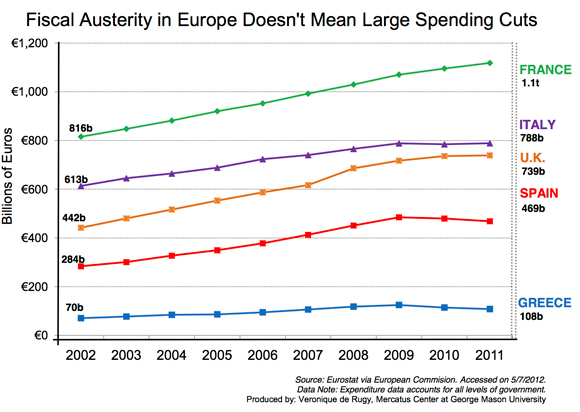
Veronique de Rugy, who compiled this data, writes:

First, I wish we would stop being surprised by what's happening in Europe right now. Second, I wish anti-austerity critics would start acknowledging that taxes have gone up too–in most cases more than the spending has been cut. Third, I wish that we would stop assuming that gigantic "savage" cuts are the source of the EU's problems. Some spending cuts have been implemented in a few countries. Also, if this data were adjusted for inflation (which I would prefer but the data isn't available) it would possibly show a slight decrease and certainly a flatter line for all countries. However, the overwhelming take away from the European experience is that a majority of governments haven't really implemented spending cuts, large or small, and some have even continued to grow.

There is further discussion at the link.  Via Pat Lynch, here you will find OECD data, no country is spending below its 2004 level.

Addendum: My response from the comments section:

The real question addressed by this post is how bad spending cuts have been in nominal terms, keeping in mind in the short run it is supposedly nominal which matters (that said, gdp and population [and inflation] are not skyrocketing in these countries for the most part).  It is fine to argue "due to automatic stabilizers, spending should have increased more than it did."  That is not how people phrase it, rather they are complaining rather vociferously about "spending cuts," many of which are either imaginary or extremely small.

From the shrillness of responses, and by the frequency of frame switching, one can see how this post and this data have hit a raw nerve.